Showing posts with label Writings. Show all posts

Sunday, September 25, 2011

Block Test 2 (Ng Eng Teng & Han Sai Por)

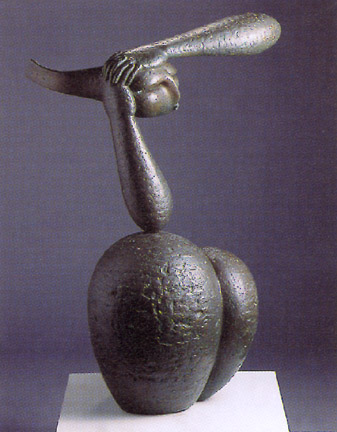
"Looking Ahead" (1987)


"Growth" (1985)


2a) Describe the subject matter of both works.
The subject matter of Ng Eng Teng's "Looking Ahead" (1987) is the human figure. The torso as well as the forearms are omitted, leaving only the head, the forearms and supposedly the thighs behind. The subject matter has been simplified, as can be seen on the face of the sculpture. By omitting the torso and forearms, viewers place more emphasis and attention on the face and the forearms, but viewers also are more aware of what is missing. In this aspect, Ng seems to have created something out of nothing. The facial expression shows that one is looking far ahead, as the eyes are squinting. There is also a trail protruding out from being the head, supposedly to suggest hair. This hair is sculpted in such a way that it looks like it is blowing in the wind. Also, the position of the arms seem to imply that the figure is trying to hold back the hair, refraining it from blocking its "vision". It gives the viewer the idea that maybe this figure is standing in a wide, windy field, looking far ahead, with the wind blowing in the hair.

The subject matter of Han Sai Por's "Growth" (1985) is abstract. There are no defined details that hint the viewers on its subject matter. It could be droplets of water frozen in time or dollops of cream. But, there is a little clue from the title of the artwork itself. The word 'Growth' suggests that something is growing. The subject matter is simplified and organic. It evokes a sense of organic vitality through how these 5 separate shapes seem to relate to each other and form one complete, whole artwork. This sculpture is absolutely white and polished smooth, and twisted into abstract shapes. The shapes each have a more pointed end on one side, and this seemingly directs the viewers' eyes around the sculpture. Its simplicity, being pure white, gives viewers a sense of tranquility and highlights essentialist beauty.

2b) Discuss similarities and differences that exist in their treatment of forms and use of materials.
Ng Eng Teng's "Looking Ahead" (1987) shows Ng's unique treatment of forms. Unlike Han Sai Por, he takes a full complete human form, dislocates it and omits the parts he does not want. He has simplified it down to what he deems as essential. For example, to him, the eyes and the mouth are the key elements of the face and are necessary in order to express emotions. He does not think much of ears, as he feels that they do not play a significant part in exuding emotions. Hence, the ears are seemingly not present and cannot be seen in this sculpture, only the eyes, the mouth and the nose. Also, after selecting the body parts he wants, he has to rearrange it into the way he wants, which is the way that best conveys the intended emotions. This sculpture, as entitled "Looking Ahead", is to portray a human figure who is looking ahead. Thus, he has given the truncated human body parts a posture which suggests the action of looking ahead.

Ng Eng Teng's "Looking Ahead" uses bronze. Bronze is a malleable and durable metal, making it very lasting. Ng thinks that art should be timeless and able to withstand the test of time. Hence, bronze, being a durable metal, is the ideal material for him to make a timeless, long lasting work of art. The texture and finish of a sculpture is also very important to Ng. In this case, it is rough, unlike Han's "Growth" which is smooth.

Han Sai Por's "Growth" is somewhat similar to Ng's "Looking Ahead" in treatment of forms. They both choose to do their sculptures in an abstract manner. However, Ng is more focused on distorting and omitting to highlight the essentials while Han is more focused on makin the sculpture organic and simple without omission. Han's "Growth" is very simplified, fluid and there are hardly any details that could suggest its subject matter. This is unlike Ng, as his sculpture still has dents and protrusions suggeting eyes, noses and hair. The arrangement of forms in Ng's sculpture is to create a human-like figure while the arrangement of forms in Han's sculpture is seemingly to form a somewhat circular, rounded shape.

As for the materials, Han uses marble instead of bronze, like Ng does. Ng picks material and explores it, and uses it for the qualities he uncovers in it after exploration. However, Han discovers the character of the material through physical context. Through the chiselling and drilling, she will understand the qualities, but she does not try to change it into what it is not. If marble is hard, then it is hard. For "Growth", she uses marble and even polished it. This shows that she understands the hardness and brittleness of marble, and her treatment of material changes with every different type of material she uses. Out of a delicate material like marble, she carved a delicate and sophisticated sculpture of "Growth". This seems to convey what she feels about man's growth being a part of nature.

2c) In your opinion, which work would you choose to be displayed in Nanyang Girls' High School as part of our permanent art collect and where will the chosen work be exhibited? Discuss with consideration given to the artist's background, repertoire of works, approaches to art, etc.

In my opinion, I would choose Han Sai Por's "Growth" to be placed in the grass patch near the main gate in Nanyang Girls' High School. I think, given Han Sai Por's strong believe that human and nature are one, her works often, subconsciously or not, exude her thoughts on that philosophy. This can be seen in her other works such as "Spirit of Nature" (1988), whose tranquil monumentality exudes essentialist beauty. The shapes of the three 'blobs' are also very simplified, organic and abstract. This seems to remind one of nature. Leaves are rather simple in their own irregular, organic shape. Hence, with regard to Han's strong interest in nature, "Growth" should be placed outdoors, in a natural setting like grass.

Apart from Han's philosophy in relation to nature, I personally feel that the organic fluidity and white colour of "Growth" will blend in well on a grass patch. It will not look out of place and will probably even enhance the beauty of the outdoor school environment. The size of "Growth" is also not exceptionally large, and on top of being white, it would not be too attention grabbing. Nature itself is not attention grabbing, it is everywhere and is very common, especially in Singapore. Thus, I think the size of "Growth" is very suitable to display outdoors in the midst of nature.

Other than the above explanation as to why I chose such a location, I think Han's sculpture embodies certain values that make it fit to be in a girl's school. Firstly, the colour white often symbolizes purity, and purity happens to be one of the four values of Nanyang Girls' High school. Next, I think the fluidity of the 'blobs' are very feminine, and really suitable for a girl's school. Lastly, I also think that since Nanyang Girls' High School already has a collection of Han Sai Por's works, adding something different of Han Sai Por will not only brighten up our school compound, but provide a larger variety. The other works that Nanyang has are made of metal, but not made of marble like "Growth". Hence, I choose Han's "Growth" to be part of our permanent art collection in Nanyang Girls' High.

some parts edited to improve my essay~

Block Test 1 (Lucia Hartini)

I actually don't remember where I've put my BT1 question paper.. So there are no questions, just answers. Some bits were edited so as to make my essays better than they actually were. (under the exam conditions and everything)

"Spying Eyes" (1989)


1a)
The colour that dominates this painting is orangey-brick red. This colour could possibly represent aggressiveness or the feeling of being restrained because Lucia Hartini feels very angry and suppressed about the gender discrimination (against women) in her society. This orangey-brick red is painted on the zig zag brick walls, and these brick walls seem to entrap a woman, who is in a vulnerable foetal position. This use of the orangey-red further reinforces the feeling of being trapped, restrained and suppressed as it surrounds the woman as though it is enclosing in on her.

The sky is the background is predominantly black with some wisps of red clouds or smog. This smog seems to be red, but as it seeps in between the brick walls, it becomes white. The black could show how bleak Lucia Hartini feels her life is, while the red-to-white clouds encroaching towards the woman could be how the society's discrimination against women is like to Lucia Hartini.

Another colour used is medium blue. The colour blue is supposed to represent power as it was worn by female warriors who protected the sultans. However, in "Spying Eyes", it is not the case. The woman's vulnerable and powerless posture makes her donning of a blue dress not powerful at all. I think Lucia Hartini's choice of blue could suggest sadness or it could also mean that maybe she would like to see herself become a strong female warrior in time to come.

The medium shade of blue greatly contrasts the bright orangey-red. It's like fire and water clashing. It draws the viewer's attention to the painting and helps in conveying Hartini's message in a subtle way.

As for the brushwork, they are very well-blended and being well-blended, it makes the forms in this painting look very realistic even though such a setting is not possible in real life. When an impossible setting is depicted in a very realistic manner, it allows the viewer to be more attracted to the painting. Personally, I think it even allows the viewer to imagine what it might be like to be in such a surrounding that is portrayed in "Spying Eyes". Giving the viewer a sense of what her message is in the painting.

Another thing is that, Lucia Hartini's brushwork brings out the fluidity or rigidity of objects, depending on what they are intended to be. The flowing, draping fabric and the hard brick walls brings out another stark contrast. Having painted the walls to be so rigid and the cloth to be so fluid, it embodies the situation Lucia Hartini is in: The harsh criticism and skeptical looks of the society against her vulnerable, soft self.

1b)
I think that the main social concern being expressed in Lucia Hartini's work is the issue of gender discrimination in her society. Lucia Hartini was born as a Catholic in a predominantly Muslim environment. The Muslim culture strongly believes that women only lived to cook and care for children, hence Lucia Hartini would most likely have felt very suppressed as an aspiring female artist at that time. This feeling of being suppressed, she would then transform it into her artworks, and this can be seen in "Spying Eyes". The woman in the foetal position dressed in flowing, blue drapery is a symbol representing the women who are suppressed in that society. The aggressively zigzagged, hard brick walls would translate into how Hartini feels confined in real life as a woman, while the eyes on the walls would symbolize the scrutinizing and doubtful eyes of the society.

Hartini is obsessed with eyes as they frighten her and she feels like they follow her everywhere she goes, watching her. This obsession with eyes can be seen in the "Spying Eyes" sequel, "Srikandi" (1993). There is a radical and vast difference between "Spying Eyes" and "Srikandi" though. In "Srikandi", the sky in the background is not as bleak as the one in "Spying Eyes", there is one straight wall and one zigzag wall. I thought the zigzag walls in "Spying Eyes" representing hurtful criticism from the society, so with one wall straight in "Srikandi", it felt like maybe Lucia Hartini did not get as much criticism anymore or maybe she just took it in her stride. Most of all, the woman in "Srikandi" is standing upright, looking very confident.

The transition from "Spying Eyes" to "Srikandi" seemingly tells people of Lucia Hartini's journey of self-discovery and self-development. She has changed from being a vulnerable and passive woman to a strong, confident woman because Srikandi is a brave and bold female warrior from the Javanese shadow puppet in the Mahabharata epic. On top of that, the woman in "Srikandi" bears a resemblance to Hartini herself in real life, thus showing that Hartini has now become a modern woman who is striving for or has already achieved some equal status in society. Also in "Srikandi", the woman stridently stares back at multiple disembodied eyes, which represent the scrutinizing and discriminating eye of the society. This is way different from the vulnerable woman in "Spying Eyes" who is already "defeated" and cowering from a beam of scrutiny from just one eye. This further re-emphasizes the fact that Lucia Hartini has grown from a passive woman, who was born to be submissive to man, to a self-confident and powerful woman, wearing the blue cloth like a brave female warrior.

1c)
Lucia Hartini, living in a society that discriminates against women, could not express her anger and frustration in a straightforward manner. To avoid more scrutiny, her works have become heavily symbol-laden. Exploring dreams and imaginations allowed her to express her personal feelings or convey personal messages subtly. For example, in "Imagination XII", she placed a wok in between two cliff-like edges and set it ablaze with explosions. This represents her anger and the wok represented how women in that society were expected to be housewives. If she had done this in a less dream-like manner, the society would easily link it back to her emotions and hence, create even more scrutiny.

I feel that Lucia Hartini's use of dreams as part of her works is very effective. Just like writers use metaphors to convey emotions, artists using symbols to convey their emotions can also be just as effective. Through Lucia Hartini's "Spying Eyes", I can read between the lines and know what it feels like to be the one lying like that on the ground. Through "Srikandi", I can feel that she no longer feels vulnerable as the woman is in a powerful stance. Through comparing "Spying Eyes" and "Srikandi", I can tell that she has changed and is no longer the submissive woman that the society intends her to be. The zigzag walls or straight walls allowed me to better understand what she feels like in that environment, whether it is painful and aggravating or whether it still feels harsh but her own personal change just bends the feeling of pain and aggravation into something that does not affect her as much anymore. I think this is all due to the fact that, her choice of symbols is very appropriate. The choice of symbols can play a big role in helping the viewers pinpoint the emotion or message that is being conveyed.

Just like "Spying Eyes" can tell me how much turmoil was in her (at that time), "Umbrella 2000" can literally show me that she feels like she carries the weight of the universe on her shoulders. In "Umbrella 2000", a woman, wearing a white dress, was shown carrying an umbrella. It looked really heavy because as the handle of the umbrella extends, it becomes the universe. The usual 'carrying an umbrella' become 'carrying the universe' through this symbolic portrayal done by Hartini.

Wednesday, May 4, 2011

Art Critics Help Viewers Perceive, Interpret, and Judge Artworks.

i think this statement is true, but i dont think it applies to all artworks. i think it should only apply to artworks that were created by the artist with a clear purpose. when there is a clear purpose, people tend to narrow down their options, and keep their eyes focused on the goal. so, for example, the Impressionists always aim to capture the fleeting light in their paintings, so their artworks always show the difference in lighting during different times of the day, or even different times of the year. one such example is Monet's famous Haystacks series.


the left one is painting during sunset, and the right one is painting on a foggy morning.


the left one here is painted near the end of summer, and the right one is painted during winter.

so when the artwork has a purpose, it most likely will show in the artwork. and that's when the art critics, with their art education and all, would be able to scrutinize the artwork, and see things that normal people are unable to see. through the eyes of a normal person, maybe Monet's painting of haystacks over and over again would get boring over time because they dont understand is so interesting about painting the same object repeatedly. but through the eyes of art critics, they are able to identify the different elements in an artwork and hence, understand the artwork too. this would make artworks more interesting to them, and after knowing the true meaning behind the artwork, based on their personal views, they will also be able to decide whether they like that artwork or whether they dislike it.

somehow it feels like they are the spokesperson for art.. but that's just what i feel. because if there were nobody to introduce art to normal viewers, unless the artwork makes a deep impression, they wouldnt be intrigued to find out more about it or even develop an interest in art. art critics are there to provide their own point of view, and shed some light for these viewers. with more information, they can develop their own views of the artwork, and maybe even develop an interest in art.

for example, Cubism. initially, i didnt really like it. it is so abstract, so avant-garde, and was almost too abstract for my liking. i mean, just look at this:


it's just a brown background with some shading, and random lines. if i didnt know anything about Cubism and if i werent in AEP but i saw this painting, i would never have known that this painting is a guitarist that is broken down into geometric shapes by Pablo Picasso, and i probably would have lost interest in it.

thus, i think that art critics really help viewers form their own opinion of artworks, especially viewers with no art education or interest in art.

however, i think that there are limits to how much art critics can help a person perceive, interpret and judge an artwork. for abstract artworks, i dont think there's an absolutely "correct" way to interpret them, especially if they were made without a clear intention in mind. if the artist created a completely abstract artwork, or even Dadaists who created artworks by chance, how, then, are art critics supposed to interpret them "correctly" when the scope is so wide that anything may be considered?

Lucia Hartini "Srikandi"


a) Describe the use of space, colour and brushwork.

The space in this painting is very dominated by the female character and the brick walls. The left side of the brick wall in the painting is a straight, slanted line that runs across the painting, as though it divides the foreground, consisting of the female character and the brick walls, from the background, consisting of the cloud-filled sky and the moon. Also, the brick walls seem to extend further beyond the painting’s boundaries, hence the space displayed in the painting appears to be rather confined, thus increasing the viewer’s attention on the female character. The dominance of the female character in the foreground also indicates the amount of emphasis Lucia Hartini has placed on her. This could be because Lucia Hartini sees herself as this resilient and sturdy character, which was actually inspired by Srikandi (a brave and bold female figure in a Javanese shadow puppet).
Where the straight line of bricks divide the painting, a strong contrast, between the vast freedom in the sky and the small, constricted space between the bricks walls, is created. The character, however, is located in the constricting space between the brick walls, which could suggest that Lucia Hartini feels very restricted in real life due to her social status. Beyond the thin, straight wall of bricks, there seems to be a small piece of sky in the painting. This small portion of the sky could represent the little freedom she owns in actual fact.
The colours used in this painting are mainly orangey-brick red and deep blue. These two colours are contrasting, and when placed side by side, they compliment each other and create a striking effect, catching the eye of the viewer easily. Red-orange tends to portray aggression and thirst for action, and suggests that Lucia Hartini's artistic capabilities could be supressed in real life. The deep blue dress worn by the female character compliments her strong stance with her hands akimbo, and surrounds her with an aura of power. Blue was also a colour worn by women's armies of the past who had the duty of protecting the Sultans of feudal Central Java, so Lucia Hartini may have intended to portray this person or herself as a brave female warrior. Deep blue against the red-orange, again, places more emphasis on the female character. The colour of the female character's skin is a tanned brown and appears to be glowing with energy and might. This portrays the female character as a strong person.
The colours in the background are the opposite of the colours used in the foreground as they are softer and less eye-catching. The light blue brings out the weightlessness of the clouds, and the pale yellow light softens the whole image altogether. The combination of light blue and pale yellow successfully depicts the vastness of the azure sky, exuding the idea of freedom. The gentle addition of the moon in the sky adds on to the calming effect, imitating the tranquility one would feel when gazing at the moon in real life.
Lucia Hartini's brushwork is similar to that of Surrealist Salvador Dali's in the sense that their brushstrokes are both exceptionally well-blended despite the fact that the details are meticulously added. As a result, they both create very realistic-looking images of the fictional world they create in their paintings. In this painting, there is a very obvious contrast between the fluidity of the dress and the hardness of the brick walls, no doubt done by her remarkable brushwork. Lucia Hartini's brushwork has conveyed her intention to contrast the flexibility of the dress and the brick walls. Her refined brushstrokes enable the viewer to see every crease on the dress and every crack on the wall, reinforcing the fact that the brick wall is unable to create the same flowing effect as the dress. This could represent how Lucia Hartini herself, in real life, has to compromise herself in order to deal with the criticism of the male-dominated society.


b) Comment on the influences behind this work.

The most obvious influence behind this work is Srikandi, because that is the title of this artwork itself. Srikandi is a Javanese shadow puppet of the Mahabharata epic, and is a brave and bold female character who projects a daring, strong and powerful image. She is the archetypical "Warrior Woman" of the Southeast Asian legend. Inspired by this, and as a result of her environment, Lucia Hartini has portrayed herself as Srikandi in this painting as the face of the female character very much resembles her own face in real life.
Lucia Hartini was born as a Catholic in a predominantly Muslim environment. The Muslim culture believes that women were born to serve men, and thus brings about gender discrimination within the Indonesian society. Women were only expected to cook and have children. This stereotypical expectation of the society may be diminished in the modern countries, but it still exists in the Indonesian world. Lucia Hartini, who chose to study art and pursure a career as an artist, has become a target of scrutiny for the critical society.
During the early years of her career, she hardly drew any human figures in her artworks, let alone a female character that resembles herself (like in Srikandi). It shows that she has come a long way from being a fearful victim of domestic violence to the secure, self-assured woman she is today.
Srikandi was an artwork marked the start of her newfound self-confidence. From the late 1970s up until she painted Srikandi, Lucia Hartini mainly painted female figures that were weak and vulnerable, just like what the society expects women to be like. However, over time, through her own experience, she decided that women should represent themselves as capable equals of men.
Living in an environment where straightforward methods of expressing herself were unacceptable caused her artworks to be filled with symbolism. These symbols help her to convey her innermost emotions subtly, allowing her to avoid the criticsm of the society. In Srikandi, Lucia Hartini has depicted how close she is to breaking free from the prison of tradition, represented by the cracked brick walls. She has conveyed her yearning for freedom through the serene sky. She has showed the viewers how strong she has become by portraying herself as the female warrior, Srikandi. Lastly, the female character in the painting is daringly looking back at many disembodied eyes. These disembodied eyes represent the society's scrutinizing eyes, which, to Hartini, felt like they followed her wherever she went and always wanted to watch her business.
In her previous work, Spying Eyes (1989), she had also used disembodied eyes, but those disembodied eyes overpowered the female character in Spying Eyes (1989), leaving her in a vulnerable foetal position. However, in Srikandi, she is staunchly staring right back at all the eyes, which demonstrates how she courageously fights for her own footing in that society. Srikandi is a work that sums up how Lucia Hartini became a confident and strong woman.

Done On: 29 March 2011

Friday, February 4, 2011

Art Stage 2011


credits to The Straits Times


Although I didnt attend the Art Stage, I did hear about one particular artwork that caused a stir. There was a man who took pictures with people who wanted to in the buff. His pose and the visitor's pose copied that of the 2 Fridas in "The Two Fridas" (1939).

Honestly, I dont have a very wide knowledge on artists all around the world. So actually, I didnt know anything about that painting, much less know anything about the painter herself, Frida Kahlo. I only knew she was a female, and she was Mexican. But, I Googled her a little, and read up a little about "The Two Fridas" (1939), and then I went to read The Straits Times article about Mr. T Venkanna, the artist who was taking photos in nude during the Art Stage.

And, I actually would like to commend him on his endeavour, because being nude, being nude in public, and being nude in public for art are all different. Being nude is like, in the shower, or when you're changing clothes. Being nude in public could be offensive or not offensive. I saw such things happen in Montmarte, the so-called 'artist square', when I went there during the AEP Europe trip last year. THAT was not offensive, but it wasnt offensive because of the crowd I suppose. They were open-minded. I'm not too sure about Singapore though. After all, being nude in public IS against the law.

But what about being nude in public for art? I would say that it shouldnt be against the law. In fact, I dont even think being nude in public should be against the law. I mean, if someone is purposely harassing you (like a flasher, who is technically naked, or something), then it would be categorized under 'sexual harassment'. Would being nude be an extra charge?? I dont know, but I think it should not be counted as an another offense.

So yes, being nude in public for art is acceptable for me. Mr. T Venkanna is very brave, and I think he is going a step further than others where art is concerned. Everybody else is doing paintings, still-life or not, otherwise its sculptures, based on nude models or not. But what Venkanna has done is pretty rare now, isnt it?

I once watched a drama, and there was this particular episode. There was a man who liked tattoos, but he wouldnt stop at just tattoos alone. Let's say he has a skull tattoo, then he would shoot a bullet at the eye of the skull tattoo, so as to create a gunshot-scar eye for that skull tattoo. Even though it is a drama, the main point is still the same as Mr. T Venkanna's art. He takes an extra step, even if it may be extreme, and he gets noticed more than the rest.

Moreover, Mr. T Venkanna's exhibit was hidden behind a black curtain, and there was a sign that warned people of the contents. So why shouldnt it be acceptable? If it's unacceptable, it should be unacceptable for Mr. T Venkanna himself, because he's the one who has to be seen in the buff by many, many strangers, and even take pictures with them.

In conclusion, I think it's taking a different path from others which makes something more outstanding. If somebody's already walked there, then a path is created. So why follow somebody else's footsteps, when you can discover a whole new way for yourself?